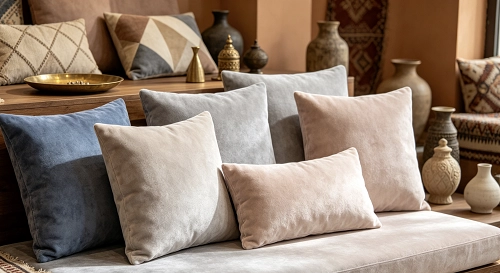

Home Decorative Fabrics: How to Judge Performance, Feel and Fit Before You Order
Home decorative fabrics cover the textiles used on sofas, curtains, bedding and cushions. Buyers often compare them by colour and price alone, yet two fabrics that look alike on a swatch card can behave very differently after two years of daily use.
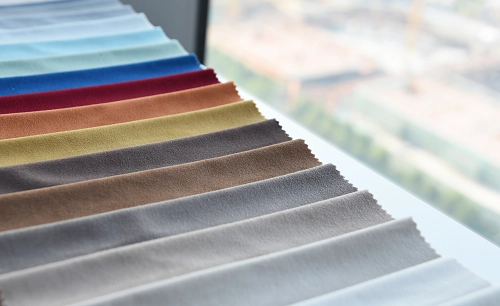
Key takeaways
- A decorative fabric has to be judged as a system: fibre, knit or weave structure, finishing, and any bonded backing all affect the result.
- Laboratory abrasion numbers are a ranking tool, not a lifespan promise. Ask for the cycle count and the test method together.
- Colorfastness to rubbing and to light matters differently by application. A sofa needs good crocking results, while a curtain by a sunny window needs good light fastness.
- Flame-retardant performance, stain resistance and similar functions are separate specifications. Confirm them per order rather than assuming them.
What "home decorative fabric" actually covers
The category is broad, and the demands on the cloth change with where it ends up:
- Upholstery (sofas, chairs): repeated friction, pressure and seating contact. Abrasion resistance, seam strength and rub fastness lead the list.
- Curtains: long exposure to daylight. Light fastness, drape and usable width matter most.
- Bedding: prolonged skin contact and frequent handling. Hand feel and colour transfer under moisture matter most.
- Cushions and throw pillows: moderate wear, but they are touched constantly, so surface feel is decisive.
Because one roll of fabric is often sold into several of these uses, a clear specification sheet is more useful than a general description such as "premium" or "high-end."
Inside KF2026-1: construction and finishing
KF2026-1 is a 100% polyester upholstery fabric supplied in 140 cm or 280 cm widths. The face cloth weighs 170–220 g/m², and it is bonded to a bottom cloth of 50–180 g/m² chosen to suit the quality grade. Adding the two published ranges gives an indicative combined weight of roughly 220–400 g/m², excluding bonding adhesive. That is a simple sum for orientation, not a measured figure.
The soft hand feel, nicknamed "Baby Face" on the product page, comes from a finishing sequence rather than from the fibre alone. The listed steps and their typical purposes are:
- Brushing: raises a fine surface nap that gives the cloth its soft, velvety touch.
- Dyeing: polyester is typically dyed with disperse dyes under heat and pressure, which supports deep, even colour.
- Softening: applies finishing agents that smooth the hand feel.
- Ironing and shearing: level the nap so the surface looks uniform.
- Heat setting: stabilises dimensions, which helps the fabric hold its width and shape during cutting and sewing.
A bonded backing adds body and helps the face fabric stay stable when it is stretched over a frame. It is also one of the first things worth discussing with your upholsterer, because backing weight changes how the cloth wraps around curves.
Reading the test data: what each figure means
The table below pairs each published KF2026-1 result with the standard behind it and a practical reading. The "Published result" column is taken from the product page.
| Test item | Standard | Published result | Practical reading |
|---|---|---|---|
| Abrasion resistance | Martindale, ASTM D4966-22 | 10+ cycles (as specified) | Ask for the exact cycle count and end point on the test report, since the end point defines what "passing" means. |
| Dry crocking | AATCC TM8 | Grade 4 | Little colour transfer to a white cloth when rubbed dry, on a 1–5 scale where 5 is best. |
| Wet crocking | AATCC TM8 | Grade 4 | Relevant to spills, damp cleaning and perspiration on seating and bedding. |
| Colorfastness to light | AATCC TM16 | Grade 3 | Adequate for typical indoor seating. For curtains in strongly sunlit rooms, request the exposure hours and colour-specific results. |
| Flame retardancy | — | No rating available | Not rated as supplied. If your market requires a flame test, specify it before ordering (see below). |
Source for the published results: HTTC product page. Method descriptions: references and below.
Three cautions when you read these numbers
1. Abrasion data ranks fabrics; it does not predict years of service. ASTM's own method notes say that lab abrasion results should not be relied on to predict wear life in a specific end use unless a relationship to real wear has been shown, and that the method is not considered satisfactory for acceptance testing of commercial shipments. Treat Martindale figures as one input next to construction and finish.
2. Pile height affects testability. The Martindale method can be difficult to apply to fabrics with a pile longer than about 2 mm. Brushed and napped cloths such as KF2026-1 have a short surface nap, so confirm that the reported test was done on the actual finished article and not on a flat-surfaced relative.
3. Crocking grades describe rubbing, not washing. The AATCC crockmeter method measures colour transferred to a white test cloth under controlled rubbing, in both dry and wet-with-water versions. It says nothing about fading under sunlight, which is why light fastness is reported separately.
Matching the fabric to the job
KF2026-1 is listed for sofas, curtains, bedding, throw pillows and cushions. Table 2 sets out what to verify for each use. It is guidance for buyers, not a guarantee, and sample testing in your own conditions is always the final check.
| Application | What matters most | What to verify before ordering |
|---|---|---|
| Sofas and chairs | Abrasion, rub fastness, backing stability | Martindale cycle count, bottom-cloth weight, any flame test your market requires |
| Curtains | Light fastness, drape, width | Light-fastness result per colour, and whether the 280 cm width suits your cutting plan, for example running the fabric sideways to avoid vertical seams |
| Bedding | Soft hand feel, wet crocking | Wet crocking grade, plus a chemical-safety certificate if the product will be sold as skin-contact textiles |
| Cushions and pillows | Surface feel, colour consistency | Shade match against an approved sample and lot-to-lot consistency |
Functional finishes and the flame-retardancy question
Beyond appearance and hand feel, KF2026-1 can be developed with functional properties such as water resistance, oil resistance, stain resistance and easy-clean performance. Specialised flame-retardant treatments to a specified standard are also listed as an option, subject to customisation and confirmation.
The standard KF2026-1 specification carries no flame-retardant rating. If you sell into a market or channel with flammability rules for upholstered furniture, name the exact standard in your enquiry and ask for the matching test report before you commit. This avoids discovering a gap after the fabric has been cut. The same applies to every other functional claim: a finish is only meaningful with a stated test method and result.
A practical procurement checklist
- Confirm the commercial terms. The listed minimum order is 1,600 metres per colour, with standard colours or custom colours matched to your sample or specification.
- Choose width and backing together. Decide between 140 cm and 280 cm, then agree the bottom-cloth weight (50–180 g/m²) with your upholsterer.
- Request the full test report. It should show the standard, the end point and the cycle count for abrasion, and the grades for crocking and light.
- Ask for a certificate for the specific article. A company-level certificate and a product-level certificate are not the same thing. OEKO-TEX® STANDARD 100, for example, is a product certification that tests for harmful substances, with stricter requirements for products with more intensive skin contact.
- Approve a lab dip or strike-off. Colour approval on the real fabric avoids disputes later.
- State any functional or flame requirement in writing before production is scheduled.
Manufacturing and sustainability context
Fabric behaviour in your finished product depends heavily on how consistently the mill dyes and finishes it. Hengsheng Textile Technology Co., Ltd. (Egypt), or HTTC, is an investment by Zhejiang Hengsheng Printing & Dyeing Co., Ltd. and is located in the Suez Canal Economic Zone. According to our Technology page, the project covers about 200,000 square metres with a total investment of 50 million USD. It is planned for 30,000 tons per year of warp-knitted fabrics, made up of 25,000 tons of dyed and 5,000 tons of printed fabrics, mainly for sofa upholstery, curtains and bedding. The site describes the project as under construction, so please confirm current production status when you enquire.
On quality and environment, our System Certification page lists ISO 9001 quality management and ISO 14001 environmental management certification, together with an international ecological textile certification. The Sewage Treatment page describes effluent flotation and biochemical treatment, waste-heat recovery and related emission-reduction equipment, and our Sustainable Development section covers wider commitments. For the company's background in dyeing and finishing, see Core Competitiveness.
Frequently asked questions
What is "Baby Face" upholstery fabric?
It is a nickname for a very soft, smooth-touch fabric. In KF2026-1 the effect comes from brushing, softening, ironing, shearing and heat setting after dyeing.
Is 100% polyester suitable for sofas?
Polyester is widely used for upholstery because it takes colour well and holds its shape. Suitability still depends on construction, finishing, and the abrasion and fastness results for the specific fabric.
Can the fabric be made flame retardant?
The standard version has no flame-retardant rating. Specialised treatments to a specified standard can be developed, subject to customisation and confirmation.
Can I order a custom colour?
Yes. Colours can be matched to your sample or specification, with a minimum of 1,600 metres per colour.
Where can I see other sofa fabrics?
Browse the Sofa Fabric range, which includes Holland Velvet, Mosha Velvet, Italy Velvet, Luna, Print, Embossing and Bronzing. The full catalogue is on our Products page.